The next useful logistics robots won't win on a stage. They’ll earn their place by moving goods through real facilities with fewer stops, safer handoffs, and less human control.
This watchlist focuses on the machine abilities that could change daily work, not on polished demos.
- Robots that pick mixed items without fixed trays
- Mobile systems that work around people and changing layouts
- Software that connects robots to warehouse tasks
Picking objects that were not placed for the robot
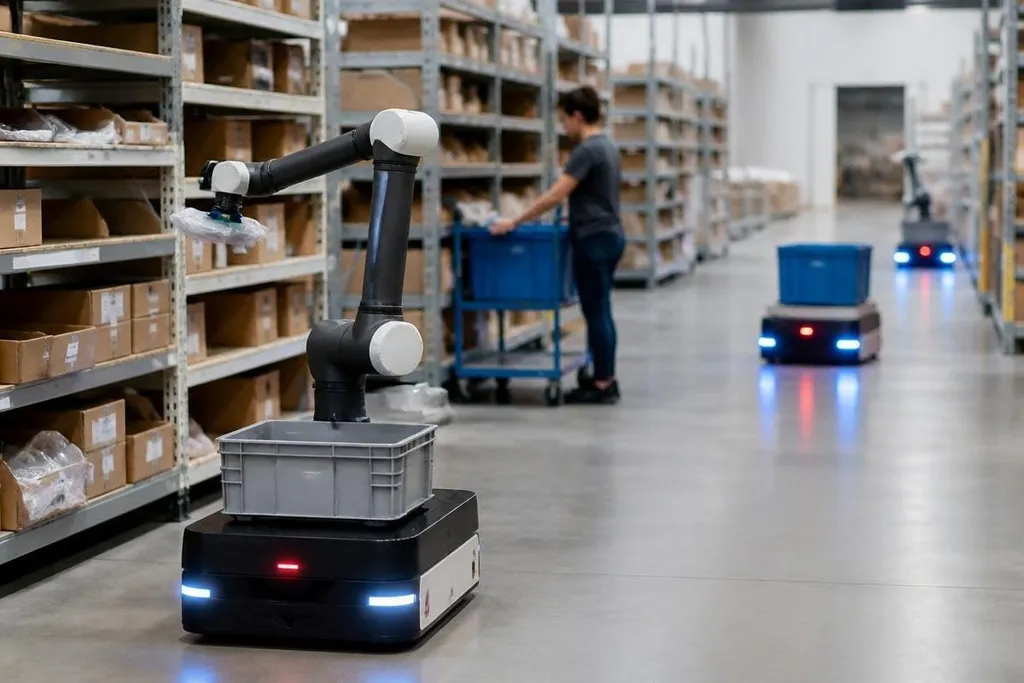
Picking remains a hard problem because warehouses contain objects with different shapes, weights, surfaces, and packaging. A robot must find an item, choose a grip, lift it without damage, and place it in the correct location.
Better handling of mixed stock is the next useful step. A system that works only with known boxes has a narrow job. A system that can deal with soft bags, sealed cartons, and objects partly covered by other items could work across more orders without a person fixing each setup.
The proof needs to show the full task. A short clip of a successful grip says little about failed picks, recovery time, damaged goods, or the number of tasks completed without remote help. Those details matter more than the robot's arm speed.
Moving safely through changing spaces
Autonomous mobile robots already move goods across controlled routes. The harder case is a busy facility where people, carts, pallets, and temporary barriers change the route during a shift.
Better sensing and route planning could help these robots slow down, stop, and choose another path without blocking work. The useful measure is not speed on an empty floor. It is how often the robot needs help when the floor is busy.
That same test applies to loading areas and yards. A robot that works inside marked lanes may need new sensors and rules before it can handle uneven ground, poor light, or mixed traffic. Those limits should appear in any serious product claim.
Systems that share work with people
A logistics robot rarely works alone. It needs task instructions, location data, safety rules, and a way to report a failed job. That makes the software connection as important as the wheels, arm, or gripper.
The useful advance will be software that lets an operator change a task without rebuilding the whole system. For example, a supervisor might redirect a robot to another zone, pause a job, or ask for human help when an item cannot be identified.
A redirect is useful only if the robot can resume the new job without a fresh setup. Robot24.com can place that claim beside a named robot, warehouse, test date, and result, giving you a clearer basis for judging the software before you study its failure records.
A good system should also show what happened after a failure. Did the robot stop safely? Did it mark the order for a person? Did it try the same action again? Those records help a warehouse team decide if the machine can run during normal work.
What still needs proof
The word “autonomous” can hide several different levels of human help. A robot may move by itself but still need a person to approve a route, fix a grip, or restart the task after a fault.
That does not make the machine useless. It changes the staffing plan and the cost. A robot that needs help twice an hour is a different purchase from one that needs help twice a shift.
The same caution applies to speed. A faster arm may not raise output if workers must wait for safety stops, if the gripper drops items, or if the robot spends too long choosing its next action. Task completion rate is the measure that matters.
A practical check before you believe the claim
Use this list when a vendor shows a new logistics robot:
- Ask for the task limits: Which item sizes, weights, surfaces, and packaging types were tested?
- Check human help: How often did an operator step in, and what did they do?
- Watch the whole run: Look for setup, failed attempts, recovery, and handoff footage.
- Compare the work cycle: Measure the full task, including travel, sensing, gripping, and placement.
- Price the support plan: Include training, repairs, software fees, charging, and floor changes.
- Name the missing proof: Write down what the demo did not show before making a purchase case.
I’d watch mixed-item picking and failure recovery first. Those abilities connect directly to daily warehouse work, and they are harder to hide behind a carefully arranged demo. A worthwhile claim will include the task limits, the human intervention rate, and the cost of keeping the robot running.